
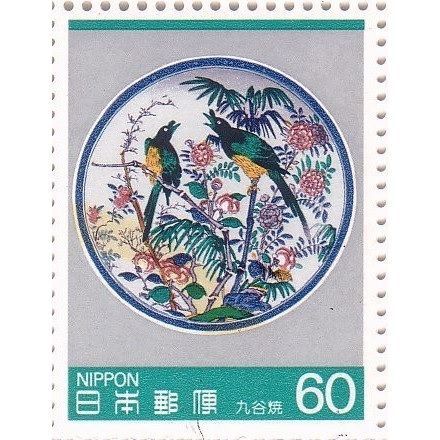
[Eisyou] (Old) 8" Decorative Dish with Design of Birds (with Stamp)
Shipping
■All items will be shipped together from Orosy's contracted warehouse in Tokyo. Shipping costs are confirmed after all items arrive and are packed. You'll be billed separately for the product cost and international shipping. For details, click here.
■The average arrival period is around 4 weeks. Please note that in case of shipping delays, supplier related as well as any other issues.
Please contact support for details regarding your shipping status.
■ All food and beverage shipments to the United States require the purchaser's FDA registration number.
Buyers who do not have an FDA registration number or cannot share it with us will not be able to place an order.
■ Shipping may not be possible depending on the country. Please check your country's regulations before ordering. Orders from areas that cannot be shipped will be canceled.
Couldn't load pickup availability
Dia. 25 x 4 cm
This is a copy of a Kutaniyaki "haha-tori" plate, which is located in the National Museum in Tokyo and is designated as an important cultural property.
It was first used on stamps in 1984, and was the first in a series of traditional crafts.
On February 19, 2017, the TV program [Nandemo Kanteidan] described this Hahadori dish as a masterpiece of Kutani. It is a very gorgeous and beautiful dish, but it was not until the Meiji period (1868-1912) that we learned that this ha-ha-tori was painted in Kutani porcelain based on a Chinese lacquer tray with the same pattern.
The lacquer tray can be seen at a private museum in Noto.
[I was sometimes asked what kind of bird the ha-ha bird is, and I thought it might be a fictitious bird since it does not exist in Japan. This Kutani ware is an important cultural property that holds many stories. It is painted by Yuzo Yamagishi, an artist selected for the Nitten and Traditional Crafts Exhibition.
Please note that there may be some iron powders and pinholes on the surface of the pot as it is handmade.




![[Eisyou] Hand-rolled Persian Arabesque Mug](http://wholesale.orosy.com/cdn/shop/files/dcd93135-af62-44af-b86e-deb3d12d988a.jpg?v=1753151428&width=550)
![[Eisyou] Red-patterned plate, small pattern, 7.5 x 7.5 cm](http://wholesale.orosy.com/cdn/shop/files/56217c8d-3657-40bc-90e7-bdad8de74428.jpg?v=1753154218&width=550)
![[Eisyou] Three-sided spittoon-shaped dish with plover design](http://wholesale.orosy.com/cdn/shop/files/d693506d-012b-4d73-b0a7-0463a1a330d3.jpg?v=1753154199&width=550)
![[Eisyou] (Lu) Silver vase with polka-dot motif](http://wholesale.orosy.com/cdn/shop/files/59185431-f853-45c9-a01b-a0853169f78d.jpg?v=1753154187&width=550)